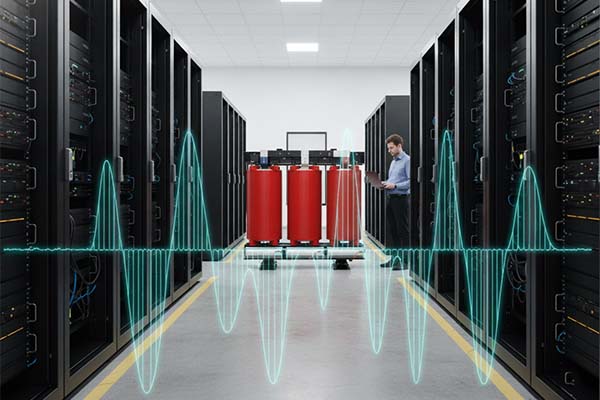
Dry-type transformers are the ideal choice for modern data centers, offering a range of intrinsic advantages such as self-extinguishing properties, eco-friendly operation, and minimal maintenance requirements, guaranteeing a safe and continuous power supply while supporting data centre operations with reliability and consistency.
With the advancement of digital technology, data centres have become more important than ever, rapidly evolving to meet the growing demand for digital services. IOT, artificial intelligence, data analytics and cloud storage are just some of the key drivers of this evolution. As massive amounts of data are generated every single day and the global data consumption continues to rise, energy efficiency, sustainability, and reliability are among the top priorities for data centre operators.
Harmonics occur when electrical loads draw non-sinusoidal current from the power supply.
Unlike traditional industrial loads, most data center equipment contains power electronics.
Typical harmonic-producing equipment includes:
UPS rectifiers
Server power supplies
switch-mode power supplies
battery energy storage systems
variable-speed cooling drives
These devices convert AC to DC using semiconductor switching. The switching process creates harmonic frequencies that distort the original power waveform.
In large data centers, these harmonic currents can reach 40–60% of the fundamental load current.
Electrical engineers designing hyperscale facilities must address harmonic distortion because it directly affects system reliability.
Major risks include:
Harmonics increase eddy current losses, raising transformer temperatures beyond normal design limits.
Triplen harmonics accumulate in the neutral conductor and may exceed phase current levels.
Distorted current waveforms increase electrical losses across the distribution network.
Sensitive electronics can experience voltage distortion that causes unexpected shutdowns.
For mission-critical environments where uptime is measured in “five nines” availability, these risks cannot be ignored.
Traditional distribution transformers were designed for linear loads such as motors or lighting systems.
Data centers operate differently.
They require transformers for data centre applications capable of handling large nonlinear loads.
Advanced data centre transformers typically include:
• K-factor harmonic rating
• reinforced neutral conductors
• low-loss magnetic cores
• improved cooling systems
• enhanced insulation systems
Modern facilities increasingly use dry-type transformers instead of oil-filled units.
Dry-type technology offers several advantages for indoor infrastructure environments.
Dry-type transformers eliminate flammable insulating oil.
They can be installed directly inside buildings without oil containment systems.
No risk of oil leakage or contamination.
Dry-type transformers require less routine servicing than oil-immersed units.
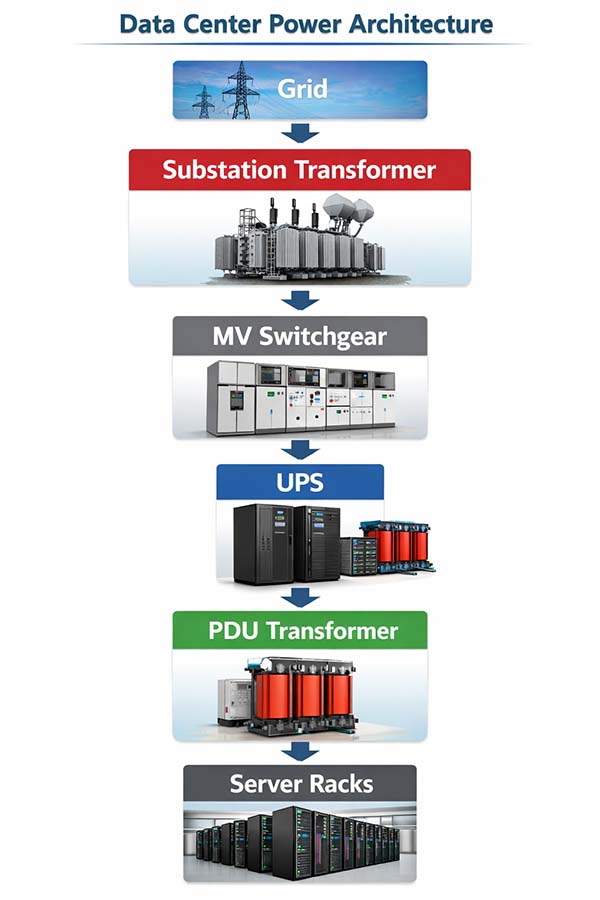
Inside the facility power architecture, PDU transformers perform voltage transformation and electrical isolation close to IT equipment.
A typical power path looks like this:
Utility Grid
↓
Substation Transformer
↓
Medium Voltage Switchgear
↓
UPS System
↓
PDU Transformer
↓
Rack Power Distribution
↓
Servers
PDU transformers help:
stabilize voltage for server loads
isolate UPS systems from IT equipment
reduce harmonic propagation
support balanced power distribution
Well-designed PDU transformers are therefore essential for maintaining stable and reliable power for data centres.
Mitigating harmonics requires both system design and transformer engineering.
K-rated transformers are designed to tolerate harmonic heating without insulation damage.
Typical ratings include:
| K Rating | Application |
|---|---|
| K-4 | light nonlinear loads |
| K-13 | commercial IT facilities |
| K-20 | hyperscale data centers |
Phase-shifted transformer configurations can cancel certain harmonic orders when multiple units operate in parallel.
This method is often used in large colocation facilities.
Passive or active filters can reduce harmonic current before it reaches transformers.
Design strategies include:
shorter cable runs
distributed PDU transformers
balanced phase loading
proper grounding systems
These techniques improve overall power quality and efficiency.
Reliable power infrastructure depends on transformers that can withstand continuous harmonic stress.
High-performance transformers designed for digital infrastructure provide:
✔ high efficiency under nonlinear load
✔ improved thermal performance
✔ reduced electrical noise
✔ longer insulation lifespan
✔ stable voltage for sensitive IT equipment
As cloud computing, artificial intelligence, and hyperscale facilities continue to expand, data center power systems are becoming more complex and demanding.
Harmonics generated by IT equipment pose a significant challenge for electrical engineers and infrastructure operators.
To maintain uptime and efficiency, facilities must adopt transformers specifically engineered for data centre applications, including advanced dry-type transformers and PDU transformers.
By combining harmonic-resistant transformer design with proper electrical architecture, operators can ensure stable, efficient, and reliable power for data centres—the foundation of modern digital services.