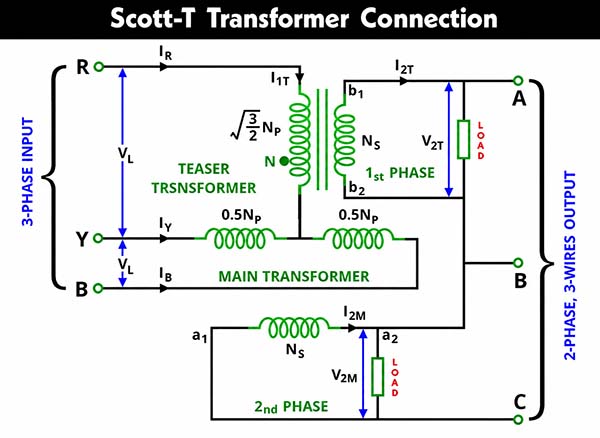
Scott-T transformer is a special transformer connection that converts three-phase electrical power to two-phase power, or two-phase power to three-phase power, using two specially connected single-phase transformers. It is commonly used for railway traction, electric furnaces and large single-phase industrial loads where improved phase-load distribution is required.
Scott T transformer or Scott T Connection is a type of circuit that can convert three-phase electric power to two-phase electric power, or vice versa. This connection was initially developed and is a practical solution for the conversion of three phase primary to a two-phase secondary. On the three-phase side a neutral point is available for grounding or for loading. On the two-phase side the windings may be connected to give three or four wire supply.
The Scott connection uses two transformers with specially arranged primary windings.
The main transformer is connected across two phases of the three-phase supply. The teaser transformer is connected between the remaining phase and the center tap of the main transformer.
The turns ratios are designed so that the two secondary outputs have:
The resulting two-phase output can then supply two independent single-phase loads or a two-phase system.
The two transformer units work together to transform the three-phase input into two electrically balanced outputs.
This configuration is different from a conventional three-phase transformer because the transformer windings are deliberately arranged to create the required phase relationship.
Advantages:
Scott-T transformers are used in several specialized industrial and electrical applications.
One of the most important applications is railway electrification.
Railway traction systems often use large single-phase loads. Connecting these loads directly to a three-phase utility network can create significant phase imbalance.
A Scott-T transformer can provide an interface between the three-phase power system and the traction power system.
This helps distribute the traction load between phases and can improve the utilization of the upstream three-phase network.
Scott-connected transformers are ideal for applications where a three-phase power supply needs to be converted to a two-phase supply. They are commonly used in railway electrification systems to power single-phase traction units.
A Scott-T transformer is a special transformer connection used to convert three-phase electrical power into two-phase power, or two-phase power into three-phase power.
A conventional Scott connection uses two single-phase transformers: a main transformer and a teaser transformer.
Its main advantage is that it allows two-phase or large single-phase loads to be connected to a three-phase electrical system while providing a method for more balanced loading of the three-phase source.
Yes. Scott-T transformers are used in specialized railway traction power applications where single-phase traction loads need to be supplied from a three-phase power network.
It can be. Both oil-immersed and dry-type solutions can be engineered using Scott connections, depending on the application. Oil-immersed hermetic designs are particularly suitable for certain outdoor and harsh-environment applications.