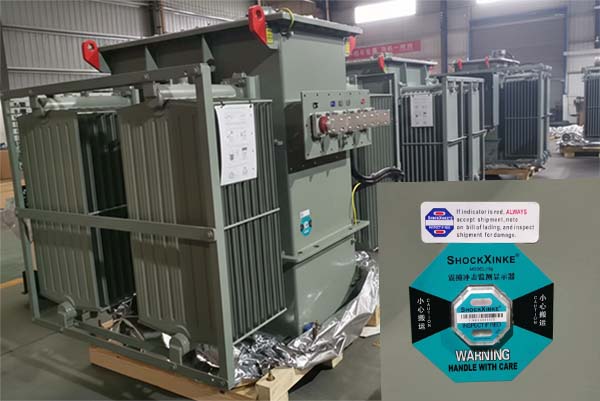
shock indicator is recommended for oil-immersed transformers above 1000 kVA or export shipments. It detects excessive transport impact, triggers inspection protocols, and prevents hidden mechanical displacement before commissioning.
A 10g shock indicator is recommended for oil-immersed transformers above 1000 kVA or export shipments. It detects excessive transport impact, triggers inspection protocols, and prevents hidden mechanical displacement before commissioning.
For medium and large oil-immersed transformers, installing a 10g shock indicator during transportation is a low-cost, high-impact risk control strategy.
It helps:
Detect excessive transport impact
Prevent hidden mechanical displacement
Protect warranty boundaries
Support insurance claims
Reduce post-commissioning failure risk
Transportation is one of the highest mechanical risk phases in a transformer’s lifecycle. Shock monitoring converts invisible risk into measurable evidence.
Oil-immersed transformers are mechanically complex and heavy. During transportation, they experience:
Crane lifting and lowering
Container loading and unloading
Long-distance truck vibration
Sudden braking or road shocks
Port handling transfers
Because of high core mass and winding compression forces, acceleration spikes generate inertia forces inside the tank.
Even a short-duration impact can:
Reduce core clamping pressure
Shift windings axially
Stress internal leads
Affect bushing alignment
Unlike manufacturing defects, transport-induced stress often remains hidden at arrival.
A transformer shock indicator is a single-use mechanical monitoring device attached to the transformer tank.
When acceleration exceeds a preset threshold (commonly 10g):
The indicator window turns red permanently
The event is recorded visually
The condition cannot be reset
The 10g threshold is widely used because:
Normal transport vibration is typically below 5g
Controlled lifting usually stays under 8g
Significant impact events exceed 10g
This makes it an effective early-warning tool without frequent false triggers.
Excessive transport impact may lead to:
Core looseness
Winding displacement
Structural deformation of clamping components
Micro-cracks in bushings
Increased vibration and acoustic noise
Long-term consequences may include:
Partial discharge
Local overheating
Insulation aging acceleration
Unexpected operational shutdown
These failures may appear months after commissioning and are often misdiagnosed as manufacturing issues.
Shock indicators provide three critical protections.
If the indicator is red upon arrival, the event can be:
Documented on the bill of lading
Photographed
Used as objective claim evidence
This creates a clear boundary between manufacturer, transporter, and insurance provider.
A red indicator activates a structured technical inspection protocol before commissioning.
It converts hidden transport stress into measurable data, reducing uncertainty.
Best practice procedure:
Accept shipment (do not reject immediately)
Record the condition on delivery documents
Take photographic evidence
Initiate electrical and mechanical testing
Recommended technical tests include:
Turns ratio test
DC winding resistance test
Insulation resistance measurement
Frequency Response Analysis (FRA)
Comparing results with factory test reports confirms whether internal displacement occurred.
The indicator signals “inspect,” not automatically “reject.”
Shock monitoring is strongly recommended when:
Transformer capacity exceeds 1000 kVA
Export or sea freight is involved
Multiple loading transfers occur
The transformer includes an on-load tap changer
The project is mission-critical (mining, power plant, wind farm, data center)
For high-value oil-immersed transformers, transport impact monitoring is considered professional best practice.
The cost of a shock indicator is minimal compared to:
Transformer repair
Project delay
Insurance dispute
Reputation damage
Unplanned outage
While it cannot prevent impact events, it significantly reduces the risk of hidden damage commissioning.
For a transformer designed to operate 20–30 years, protecting it during transportation is a rational engineering decision.
Oil-immersed transformer shipping damage is a real and measurable risk.
A 10g shock indicator does not complicate the system.
It adds accountability, traceability, and decision clarity.
For export projects and high-value transformers, transport shock monitoring is not an accessory — it is a structured risk management tool.
It is not legally mandatory in most regions.
However, for export shipments, high-value units, or transformers above 1000 kVA, it is strongly recommended as best practice for transport risk management.
10g represents a practical balance:
Below normal vibration limits
Above typical controlled handling acceleration
Sensitive enough to detect meaningful impact events
It reduces false alarms while detecting genuine structural risk.
Not necessarily.
It means the transformer experienced an acceleration event above the safe threshold.
Technical testing must be performed to determine whether mechanical displacement occurred.
The indicator signals “inspect,” not “reject.”
In most cases, no.
Internal mechanical changes often leave no visible external signs.
Only electrical and mechanical testing can confirm integrity.
For small, locally transported units with minimal handling, risk is lower.
For:
Long-distance shipping
Sea freight
Multiple transfers
Heavy units
Shock monitoring is highly advisable.