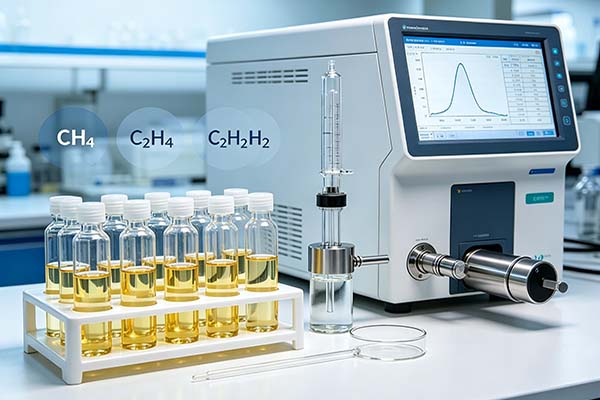
We take oil samples for laboratory analysis that assesses the condition of the insulating oil: moisture content, acid number and breakdown voltage. Dissolved gas analysis (DGA) also provides early warning of developing faults – such as overheating or partial discharges – long before they can develop into a breakdown. DGA can tell us something about the type of fault; electrical measurements can locate it.
Distirbution Transformer failures rarely happen without warning. Insulation degradation, thermal stress, mechanical movement, and contamination often develop gradually, producing early signals long before an outage occurs. Varelen focuses on diagnostic testing that captures those signals, helping asset owners and operators understand transformer condition, monitor trends, and address issues before they escalate into failures.
1. What is the DGA Test?
DGA (Dissolved Gas Analysis) is a key method used to evaluate the dissolved gas content in the insulation oil of oil-immersed transformers, and to determine the internal state and potential faults of transformers. When the transformer is running, due to electrical, thermal and other reasons, insulating oil and insulating materials may decompose and produce different kinds of gases. By detecting the composition and concentration of these gases, faults inside the transformer can be detected in advance.
2. The importance of DGA testing
DGA gas analysis is considered to be one of the most effective tools for predicting transformer failures. It can detect a variety of potential problems, such as partial discharge, overheating, insulation aging, etc., to ensure the safe operation of the transformer. This is particularly important for maintaining the stability of the power grid and reducing power outages.
3. Common gas types and their meanings
DGA analysis typically detects the following gases, each of which corresponds to a different type of failure:
4. DGA gas analysis method
In DGA analysis, the gas is dissolved in the transformer oil, which is then separated and analyzed by gas chromatography. The main methods include:
Gas chromatography: This is the most widely used method in DGA testing and can accurately detect the concentration of different gases.
Rogers Ratio Method: By comparing the concentration ratio between different gases to determine the type of failure.
Total fault gas method: The sum of all gas concentrations is used as an evaluation index of transformer health status.
5. Interpretation of DGA test results
The interpretation of test results is the key to DGA gas analysis. Different gas concentrations and their proportional variations can provide important clues about the health of the transformer. For example:
If a large amount of acetylene gas is detected, it may mean an arc discharge and prompt immediate shutdown for maintenance.
If the methane and ethylene levels are elevated, it indicates that there may be overheating inside the transformer.
6. Practical application of DGA gas analysis
In practical applications, DGA gas analysis can help maintenance personnel identify potential transformer failures in advance, avoiding greater damage and power outages. For example, many power companies regularly conduct DGA inspections to establish transformer health records to ensure the safe operation of transformers.
The benefit of DGA testing
1. Detect faults in advance to reduce downtime
2. Reduce maintenance costs
3. Extend transformer life
4. Ensure the reliability of power system
By DGA testing, you can not only detect potential transformer hazards in advance, but also significantly reduce maintenance costs, extend equipment life, and ensure reliable operation of the power system. As a professional transformer manufacturer, we are committed to providing you with accurate and reliable diagnostic services to keep your equipment in top condition at all times, avoiding unplanned downtime and costly repairs. Choose us, you choose peace of mind and efficiency, escort your business, so that every moment of the future is full of motivation and confidence.
Your equipment, we guard.
Frequently Asked Questions
Transformer oil analysis is a laboratory test that evaluates the condition of insulating oil inside a transformer. It measures factors such as moisture, acidity, dielectric strength, and contamination to determine whether the transformer is operating safely and whether maintenance is needed.
DGA provides early warning of internal transformer problems that cannot be seen during routine visual inspections.
It helps detect:
Finding these issues early can significantly reduce repair costs and unplanned outages.