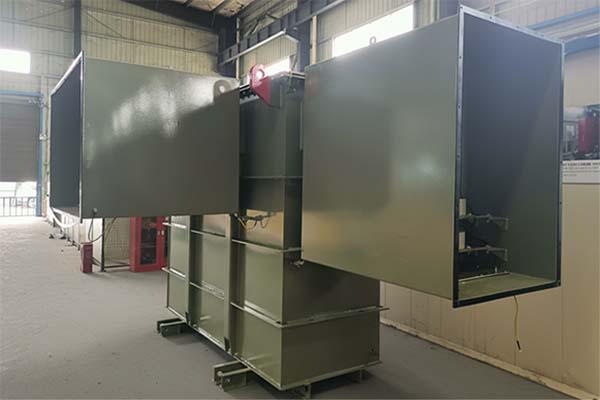
Earthing transformer is a dedicated protective device with high thermal stability, ultra-low zero-sequence impedance and dynamic magnetic circuit balance capability. It eliminates the neutral point displacement voltage through extremely low impedance and ensures the sensitivity and high reliability of the 33kV system grounding protection with a strong overload capacity of 5000A.
Modern distribution networks—particularly those integrating high-capacity industrial loads, wind farms, and solar arrays—demand highly responsive utility-grade grounding strategies. When the grid configuration lacks an accessible neutral point, the deployment of a specialized earthing transformer becomes mission-critical.
This paper provides a rigorous engineering assessment of an earthing transformer specified at 33kV, 5000A for 10 seconds, featuring a ZN (Zigzag) vector group. It examines the underlying electromagnetic mechanics, transient thermal mitigation, and overall lifecycle layout economics.
Because some power systems have no neutral point, and protection systems can’t work properly without one.
Simple as that.
Take a delta-connected system. Great for certain industrial applications. Reliable. Efficient. But there’s no direct neutral available for grounding.
That creates a problem.
When a single line-to-ground fault occurs, the system voltage can become unstable. Healthy phases may experience overvoltage stress. Insulation ages faster. Fault detection becomes difficult.
That’s where the grounding transformer steps in.
It creates an artificial neutral.
Now the system can:
Honestly, it’s like adding guardrails to a mountain road. You hope you never need them. But you definitely want them there.
A zig-zag transformer is the most common grounding transformer design for industrial and utility systems.
And honestly, engineers love them for good reason.
The winding arrangement cancels balanced three-phase currents while allowing zero-sequence fault current to pass during a ground fault.
Pretty clever design.
You’ll see zig-zag grounding transformers all over renewable energy plants and medium-voltage substations these days.
Especially in solar farms.
The greatest technical advantage of ZN (zigzag) wiring lies in its magnetic circuit cancellation effect.
physical mechanism
When a single-phase grounding fault occurs in the system, zero-sequence current flows through the two reverse windings of the same core column, generating magnetic fluxes of equal magnitude but opposite directions, which cancel each other out in the core.
5000A / 10s
As an intermittent operating system equipment, this transformer does not need to be designed for long-term continuous full-load like the main transformer. Instead, it has been deeply optimized for High Thermal Mass. The 10-second mechanical and thermal stability withstand time (usually far exceeding the action time of the conventional main transformer grounding protection) provides the system with an extremely high safety margin, ensuring that the transformer windings will not be burned out due to internal overheating in extremely harsh conditions, even when the protection fails to operate or reclosing fails.
technical specification:The ZN type wiring is balanced and symmetrical。
technical specification:The ZN wiring can be expanded to composite wiring such as ZNyn11.
technical specification:Design against transient electromagnetic force.
Project benefit:A sudden current of 5000A will generate a huge electromagnetic electromotive force (proportional to the square of the current). The symmetrical winding structure of the ZN connection makes the axial and radial electromotive force distribution relatively uniform. Combined with the targeted end insulation fastening design, it has the ability to resist Mechanical stress Deformation caused by high-intensity short-circuit current.
An earthing transformer is usually associated with three-phase supply systems.
The neutral would be earthed directly or through some limiting impedance/resistance on a three-phase system. When the neutral point is unavailable or does not exist with a delta secondary winding of the transformer, a neutral point needs to be created. This is the purpose of the earthing transformer, which could consist of a zig-zag winding or a two-winding star delta transformer where the star winding of correct voltage supplies an accessible neutral point when connected to the supply system.