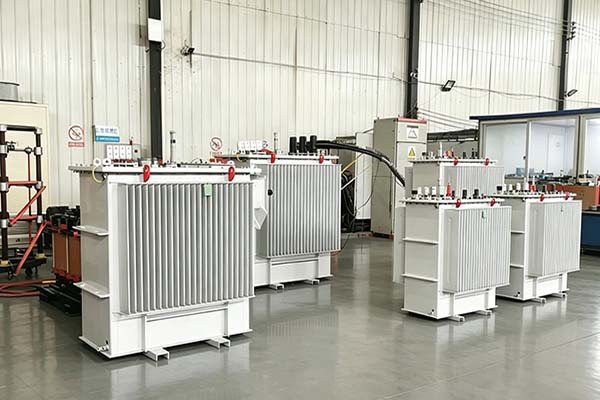
Energy storage systems rely on dependable transformers to deliver safe, stable, and efficient power. At Varelen, we design and manufacture high-performance transformers that integrate seamlessly into energy storage applications. Whether supporting industrial facilities, commercial buildings, data centers, or EV charging infrastructure, our transformers ensure reliable operation, optimized efficiency, and long-term durability.
A BESS transformer is a specialized transformer designed to connect battery energy storage systems with medium-voltage or high-voltage electrical networks.
In a typical BESS installation, electrical energy flows through several stages:
Battery System → Power Conversion System (PCS) → Transformer → Medium Voltage Grid
During charging, electricity flows from the grid through the transformer and PCS into the battery.
During discharge, the energy flow reverses. The transformer transfers power from the battery system back to the grid.
This bidirectional operation creates different requirements compared with conventional transformers used in traditional power distribution applications.
Many engineers initially ask:
“Why can’t we simply use a standard transformer for a BESS project?”
The answer is that BESS applications create several challenges.
Traditional transformers usually operate with power flowing in one direction.
BESS transformers must support energy movement in both directions without affecting efficiency or reliability.
The transformer design must consider:
The Power Conversion System (PCS) uses semiconductor devices to convert AC and DC power.
These electronic switching processes generate harmonic currents.
Harmonics can cause:
A BESS transformer should include appropriate design considerations for harmonic environments.
Unlike traditional industrial transformers that may operate at relatively stable loads, BESS transformers experience rapid changes.
A typical day may include:
This requires strong thermal performance and mechanical reliability.
The transformer performs voltage conversion between the PCS and the electrical grid.
For example:
A battery system may operate at a low DC voltage level. The PCS converts DC power into AC power. The transformer then increases the voltage to a medium-voltage level suitable for grid connection.
A typical BESS transformer configuration may include:
The transformer acts as the bridge between energy storage equipment and the power network.
Selecting a transformer for a BESS project requires more than checking rated power.
Engineers should consider several factors.
Transformer capacity depends on:
Common utility-scale BESS transformer ratings include:
The voltage level depends on the project design.
Common configurations include:
The transformer must match the PCS output voltage and grid connection requirements.
BESS transformers are available in different cooling designs.
Advantages:
Advantages:
Dry-type transformers are becoming increasingly popular for projects located near buildings, urban areas, and sensitive environments.
| Feature | Dry-Type Transformer | Oil-Immersed Transformer |
|---|---|---|
| Fire safety | Excellent | Requires oil protection measures |
| Indoor installation | Excellent | Limited depending on regulations |
| Maintenance | Low | Requires oil monitoring |
| Environmental impact | Lower | Requires oil management |
| Large power applications | Suitable | Excellent |
| Outdoor utility projects | Suitable | Widely used |
The correct choice depends on project location, power rating, safety requirements, and operating environment.
BESS transformers are widely used in different energy applications.
Large battery farms use transformers to connect storage systems with transmission and distribution networks.
Applications include:
Solar generation is naturally dependent on weather conditions.
BESS helps store excess solar energy and release it when demand increases.
The transformer enables efficient connection between solar storage systems and the grid.
Wind power output changes constantly.
Energy storage combined with suitable transformers improves grid stability and power quality.
Factories, mining operations, and remote facilities use BESS to improve energy security.
Reliable transformers ensure continuous operation during changing load conditions.
Because BESS projects often represent significant investments, transformer monitoring is essential.
Recommended protection and diagnostic methods include:
For oil-filled transformers, DGA can detect:
Monitoring winding and oil temperatures helps prevent thermal damage.
Common tests include:
A condition-based maintenance approach helps operators reduce unexpected failures.
Choosing a transformer supplier requires evaluating more than product price.
Important factors include:
A qualified supplier should understand:
Check:
Every BESS project is different.
A reliable supplier should provide customized solutions based on:
Varelen designs and manufactures transformers for modern energy applications, including renewable energy projects and battery energy storage systems.
Our transformer solutions focus on:
Whether your project requires an oil-immersed transformer or a dry-type transformer, Varelen works with EPC contractors, utilities, and energy developers to deliver reliable power conversion solutions.
BESS systems commonly use medium-voltage transformers designed for bidirectional power flow between the PCS and electrical grid.
A standard transformer may not be suitable because BESS applications involve harmonics, frequent cycling, and reverse power flow.
A BESS transformer is specifically designed to handle dynamic loads, harmonic currents, and bidirectional operation.
Yes. Dry-type transformers are suitable for many BESS applications, especially indoor installations where fire safety and environmental protection are important.