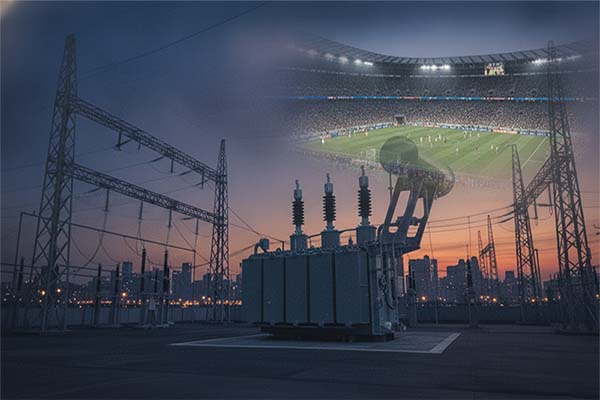
The result is a sudden surge in electricity demand that can place significant stress on national power grids. During the 2022 FIFA World Cup, the UK's National Energy System Operator (NESO) reported that England's matches caused electricity demand spikes of approximately 600 MW. That is equivalent to the power consumption of two large cities appearing almost instantly on the grid.
Imagine millions of people watching the same football match at the same time.
The referee blows the whistle.
Televisions turn on.
Air conditioners keep running.
Refrigerators are opened more often.
Kettles start boiling during halftime.
Microwaves heat late-night snacks.
Now multiply that behavior across millions of households.
The result is a sudden jump in electricity demand that can put real pressure on national power grids.
During the 2022 FIFA World Cup, the UK’s National Energy System Operator (NESO) reported that England matches caused demand spikes of around 600 MW. That’s roughly equivalent to adding the load of two large cities almost instantly.
For utilities, EPC contractors, and power engineers, this raises a simple but important question:
How does the grid stay stable when demand changes so quickly?
It’s easy to assume stadiums are the main cause of increased electricity use during big games.
In reality, they account for only a small part of the total load.
The modern football stadium typically consumes around 13–15 MW during a match, covering:
Compared to a nationwide surge of 600 MW or more, stadium usage is relatively small.
The real driver is synchronized behavior at home.
Millions of people do the same things, at the same time:
Power systems are designed around a constant balance between supply and demand.
When demand rises quickly, several issues can appear:
Voltage dips
Distribution networks may experience short-term voltage drops.
Thermal stress on equipment
Transformers and switchgear operate at higher temperatures under increased load.
Higher electrical losses
Current increases lead to more energy losses across the system.
Grid balancing pressure
Operators must adjust generation and transmission in real time.
Long-term wear on equipment
Frequent load swings can speed up insulation aging and reduce asset life.
This is why grid infrastructure is built with strong safety margins and reliable core equipment.
Like a goalkeeper in football, transformers usually work quietly in the background.
They rarely get attention unless something goes wrong.
But without them, the power system would not function.
power Transformers are responsible for:
When demand suddenly increases, distribution transformers are one of the first assets that determine whether the system remains stable or becomes stressed.
For EPC contractors, distribution transformer is not just a equipment—it is a long-term reliability decision.
Key points are include:
Ability to handle temporary overloads
Industrial sites and utilities often face short-duration peaks.
Low temperature rise design
Lower operating temperatures help extend insulation life.
Strong short-circuit strength
Mechanical durability is critical during fault events.
High efficiency performance
Reducing losses directly lowers lifetime operating cost.
Compliance with international standards
Their load is not constant—it changes rapidly depending on computing demand.
Modern data center transformers are typically designed for:
These characteristics help maintain stable power delivery even during rapid load shifts.
Whether it’s a major football match, an industrial startup, or an AI data center scaling computing load, the challenge is the same:
The grid must handle sudden changes in demand without disruption.
Transformers sit at the center of this requirement.
As electricity demand continues to grow and become more dynamic, the role of transformers in grid reliability will only become more important.
At Varelen, we design and manufacture transformers for utility, industrial, renewable energy, and data center applications.
Our focus is on equipment that performs reliably under real operating conditions, including load fluctuations and demanding environments.
Our transformers are designed for:
Across global power systems, our transformers are used in infrastructure where reliability matters most.
When demand changes suddenly, the goal is simple: keep the system stable and running.
Can sporting events affect national electricity demand?
Yes. Large events can cause synchronized electricity use across millions of households, leading to noticeable short-term demand spikes.
Why are transformers important during peak demand periods?
They help regulate voltage and distribute power, supporting grid stability during sudden load changes.
What industries rely most on high-reliability transformers?
Utilities, data centers, renewable energy, manufacturing, mining, oil&gas, healthcare, and critical infrastructure sectors.